March 23, 2026
How I became a French citizen
Everything I know about applying for and getting French citizenship by naturalization — my process, timeline, and lessons learned.
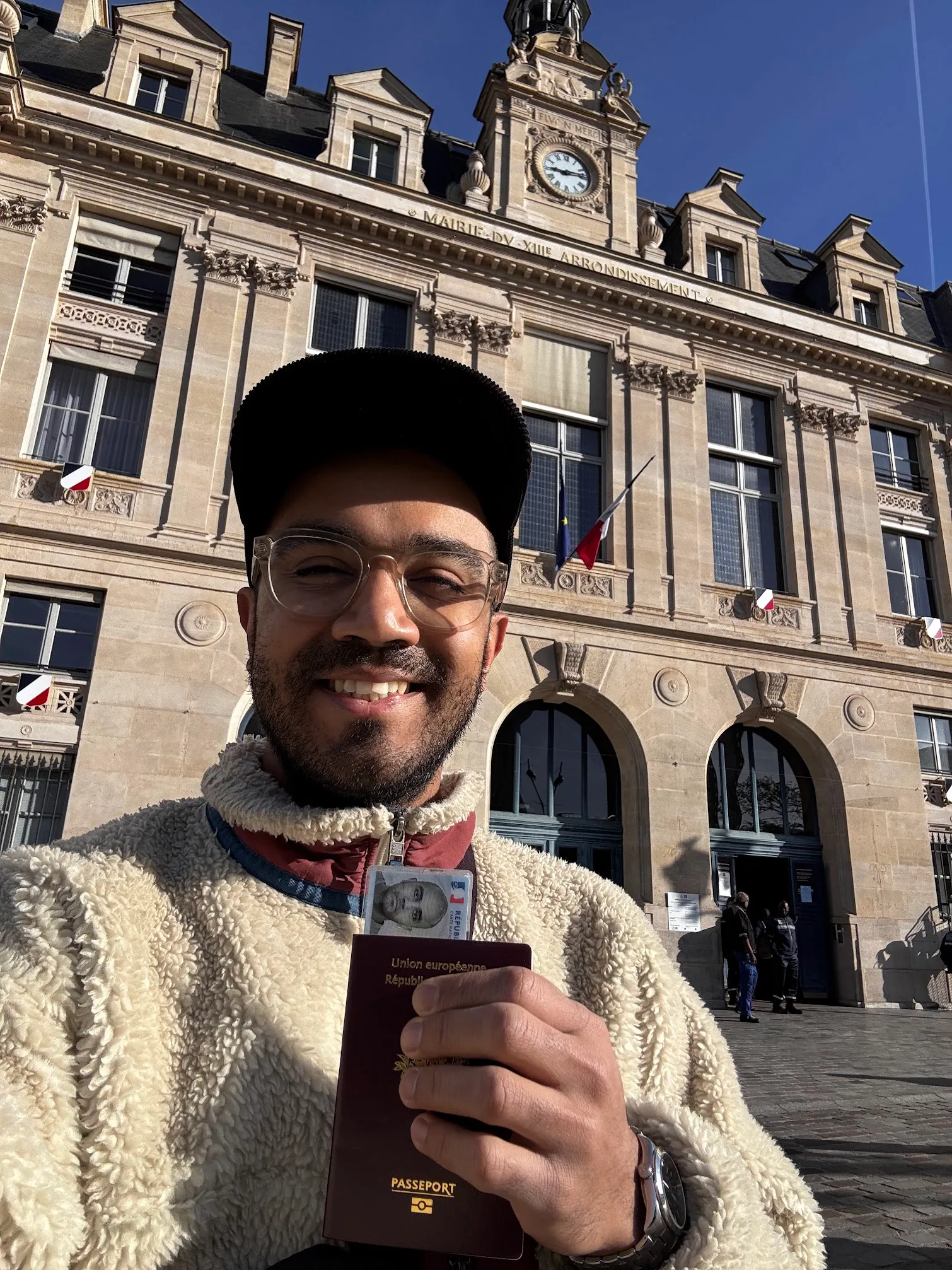
Earlier this month, I finally became a French citizen and I just got my French passport.
It feels absolutely unreal. I have been waiting for this moment ever since I came to France more than 7 years ago, and it’s been a long and very uncertain journey to this point.
If you live in France as a foreigner, you’ll know what I’m talking about.
I applied for French nationality by naturalization a year and a half ago, and since then I’ve been reading about the experiences of so many people that went through the same process.
In this article, I’m going to break down everything I know about applying for and getting French citizenship by naturalization. I’ll share my own process, and I’ll also share all the things that I learned along the way.
Most importantly I’ll share mistakes that I made as well as I’ve seen other people make and how to avoid them. So let’s get into it.
What makes you eligible to apply for naturalization?
You’re eligible for naturalization when you’ve lived in France for five years or longer, and this duration can be reduced to two years if you’ve studied a master’s that’s at least two years long, in France.
You also need to continue to be living here when you apply for naturalization and throughout the process, all the way until the end.
That being said, just meeting the duration and residency requirement is just the bare minimum. You also need to meet other conditions like the following —
FIRSTLY, You are “sufficiently economically integrated” into France.
-
What does sufficiently economically integrated mean?
This means that you’ve been working for at least 18 months, and earn at least the minimum wage, whether you’re a salaried employee or a business owner, and your income is more than 50% from French sources.
If your business is registered in France, it doesn’t matter where your clients are, because your income is still considered as French income.
-
What I’ve seen is that people that live in France but work remotely for foreign companies, or have a business registered elsewhere as their only activity, often get rejected because their income is not seen as being French sourced.
-
Another recommendation is that, ideally, you should clear the trial period on your job before you apply, because if you lose your job during the application, it could make things a bit uncertain.
-
A final recommendation is that it’s better to do this when you’re on a CDI because you’re less likely to be unemployed during the course of your application. If you have a short-term CDD, there’s a chance that you’ll be unemployed and that can make things a bit uncertain as well.
-
That being said, I have heard of people who’ve been working for a really long time but were unemployed during part of their application, and it turned out fine.
It’s not a black and white rule. They’ll consider your overall economic integration when they study your profile. To me economic integration is probably the biggest factor in your application getting accepted or rejected.
SECONDLY, You also need a B2 level of French. And this requirement can actually be waived if you’ve done any higher studies in France as well, including a master’s, if your studies were in French.
Otherwise I would really recommend starting to learn French from the very beginning so that you get to a B2 level as soon as possible, so that this doesn’t hold you back when you want to apply.
NEXT, You need to qualify the civics exam.
This is a new requirement starting in 2026, for everyone that’s applying after January 1st.
THEN, You need to have filed your income tax return at least three times, because they ask for the last three income tax returns when you submit the application.
-
Keep in mind that even as a student, with zero income, you can still file an income tax return.
I would recommend filing your income tax return from the first year that you move to France, even as a student. That way you get to three of them filed sooner!
FINALLY, France needs to be the centre of your personal and financial interests.
This means that if you are married and your partner lives outside of France, your application is likely to get rejected. This is actually explicitly stated on the French government website for naturalization.
It also means that if the vast majority of your investments, your property, and all of that (if you have any) is outside of France, back in your home country for example, your application is also likely to get rejected.
The authorities want to see that you seriously consider France as the centre of your life and that you are likely to continue living here after you get the nationality.
If you’ve cleared all of these points, it means that you’re probably ready to apply for naturalization.
But there are a few, really annoying places that most people still get stuck even after they qualify all of these points.
Where most people get stuck
You need your parents’ birth certificates and marriage certificate as part of the application.
For me being from India, for example, where people born 60 years ago didn’t really have proper birth certificates or maybe they hadn’t kept them, getting these documents was a complete pain.
I know of another person whose application got stalled and eventually rejected because he couldn’t get these documents in time after he applied.
I have heard of instances where people managed to get away without a birth certificate but having some kind of an attestation from a high court, but it’s extremely uncertain whether that works or doesn’t work and it really just depends on the officer that’s handling your file.
Unfortunately I can’t give you advice on how to get your parents’ birth certificates even if you’re Indian, because India is a huge country and different municipalities handle this in different ways.
My parents were born in New Delhi so it was a little bit more straightforward but it still took about a year and a half for both my parents to get their birth certificates.
I’m extremely grateful that they worked towards it, because it required them finding tons of different proofs that they were born in Delhi, and submitting an application to get a birth certificate at the Delhi Municipal Corporation. It was a whole thing.
So my advice would be that the moment you know that applying for naturalization is something that you want to do, even if you’re not eligible yet, start arranging for this as early as possible because you never know how long it will take.
The second place where most people get stuck is your own birth certificate.
But I’ll get to that when I talk about my application timeline in the next section.
Application process, step by step
The entire application took me one year and four months, from the day I started my application till the day I officially became French.
Let me tell you exactly step by step the process that I had to follow.
Collecting Your Documents
Before you make your application, you need to collect all of your documents. This is kind of like step zero.
You can get a detailed list of all the documents that are necessary on this link.
https://www.service-public.gouv.fr/particuliers/vosdroits/F34741
Except for yours and your parents’ birth certificates, all other documents are generally pretty straightforward to get.
Keep in mind that all documents that are not in French need to be translated to French by a sworn translator that’s approved by the French government. Here’s a link to help you find a translator like that.
https://www.service-public.gouv.fr/particuliers/vosdroits/F12956
Your birth certificate also needs to be apostilled. Here’s a link that helps with the apostillation process.
https://prasanthragupathy.com/2024/09/apostille-process-of-indian-birth-and-marriage-certificates/
Application Form
Then, the first step is starting your application on the foreigners’ portal.
I made my application on the 12th of October 2024.
Once you start your application, you’ll have a long form that you have to fill out with all the details of your life and upload all the documents that are requested.
Depending on your personal situation you might have to contact or make a few trips to different embassies to get your police clearance certificate, because you need one for every country that you’ve lived in, for more than six months in the last 10 years.
Thankfully in my case I only needed the Police Clearance Certificate from India, since my time in the U.S. in 2019 was five months long. If you need one from India as well, it’s pretty easy to get from the Indian Embassy in Paris. For other countries you might have to look it up yourself.
You also need to pay a €55 fee by purchasing a timbre fiscale, which you can do online.
Filling up the form can take at least an hour or an hour and a half because it’s pretty long and detailed.
After you’ve submitted the form and all of your documents, the next thing you need to do is just wait for them to come back to you. If you don’t hear anything back, that is a good thing.
Additional Documents
In my case they actually came back after two days, telling me that one of the documents that I’d uploaded was not acceptable.
So different people get asked for different additional documents, and in my case it was my birth certificate.
It turns out that France does not accept birth certificates that have a QR code on them. So they asked me for a birth certificate that did not have a QR code on it.
Unfortunately for me, the City of New Delhi only gives out birth certificates that have a QR code on them.
My original birth certificate from 1996, which didn’t have a QR code, also did not have my name on it. So the new one that I got from the city of New Delhi is the only one that I had.
I was pretty stressed about this and I thought that I would be completely stuck… But then one of my parents had the idea that we can try to get a printout of my digital birth certificate, stamped and signed by the Registrar of Births and Deaths in the municipal corporation of New Delhi.
So we did that, and thankfully it was accepted. I uploaded my updated birth certificate on the 8th of November 2024, about a month after the first application.
I’ve actually heard of other people having the same situation with the QR code from different countries, not just India. What I’ve seen working is to simply try and get a certificate that does not have a QR code, and if you fail, try and get some kind of stamp and signature by a real person.
When you upload your document, you can also attach another PDF file with an attestation, which is basically like a letter that you write explaining the situation as well. If you explain that you really tried your best and it’s just not possible and give them a very clear reason why, they can sometimes accept it.
Interview
The next step is getting invited to an interview.
I got an invitation for the interview on the 14th of August 2025, so that was ten months after starting my application. My actual interview was held on the 17th of September, 11 months after submitting my application.
Before 2026, the interview included questions about your personal life, your integration, as well as a quiz on different French history and civics topics.
Now, my understanding is that the civics exam takes the place of the quiz that was previously there during the interview, and the interview will now largely focus on your personal situation in France and testing how well integrated you are in the country.
Another purpose of the interview is to test your French level. Because of course, the entire interview is going to be in French, you need to be able to converse in French during the interview and answer any question that you’re asked.
So even if you somehow manage to waive the French language test in your application, that doesn’t exempt you from waiving the language requirement.
It’s also during the interview that you can submit any additional documents that you want to include in your file. In my case I actually bought an apartment during the time between when I made my application and the interview, I wanted to include it in my file, since owning property in France greatly demonstrates your integration.
This is also where they ask you for updated documents about your job, for example. I had to bring to my interview my last three pay slips as well as updated financial documents like the latest income tax return.
So this is what I mean by if you actually lost your job, for example, after applying and before the interview. They will know about it because they will ask you about it during the interview and you will have to show documents.
So what questions were asked during the interview? Here they are, not in a strict order, but the first few questions were asked first:
- How long have you been in France?
- Why do you want to become French?
- What are the different ways a citizen can vote in France? (this was a follow up to me saying that I want to be able to vote, in my previous response)
- What is the nationality of members of your entourage — friends, colleagues, etc.?
- What does your partner do in France? Has she applied for nationality as well?
- Name some of the “Rois” in France
- What happened in the reign of Henri IV?
- Tell me something about Louis IV?
- What happened in the reign of Louis VI?
- What was the year of the French revolution?
- Is there still “peine de mort” in France? What year was it abolished?
- Which republique are we in? Who was the founder of the Veme republique?
- What is Laicite? What does it mean to you? (this was a longer discussion)
- What is Liberte?
- Have you traveled around France? Name some cities you’ve been to.
- Name a few mountain ranges in France.
- What are some French foods you like?
- Do you watch cinema? Name some movies/actors/actresses.
- What music do you listen to?
- Does your partner listen to the same music? What artists does she listen to? (that was a weird one, I wasn’t expecting that)
- What are the different parts of the parliament?
- Do you have close family in India still? How often do you visit them?
But overall I would say that the interviewer was extremely nice. She was really sympathetic and she even helped nudge me to the right answer sometimes if I fumbled here and there.
I was a little bit nervous, and when she could sense that she really put me at ease.
I was so anxious for the interview but once it was done I was so relieved and I think it went really well.
At the end of the interview she told me that it can take anywhere between six months and a year to hear back.
She also told me that if I don’t hear anything, that’s not a bad thing. Because generally if they want to reject you, they tell you pretty quickly after the interview.
Waiting…
After the interview the only thing I had to do was wait.
In the middle of December I saw that my file had moved to the first SDANF stage.
Three weeks after that, on the 7th of January, I saw that my file moved to the SCEC stage and immediately after that to the second SDANF stage.
Decision, and publication in the Official Journal (or JO)
Exactly a month after that, on the 6th of February 2026, I saw that my name appeared in the official journal of France, and I was officially a French citizen from that day onwards.
So again all in all it took a year and five months from submitting my application to getting my passport.
My complete timeline
Emotional + psychological side of the process
Applying for nationality can be a really emotional process.
Stability
My entire life is in France. I own an apartment here. My fiancé is here. My work is here. All of my friends are here. Aside from my parents and my sister, all of the other important things of my life are here in France.
And up until now, I always felt a little bit nervous and unstable that I am on a work visa. You hear about a lot of things, especially from people in the US, where their lives can be really unpredictable because of their visa.
Even though in France visas are generally pretty stable and predictable, it always made me a little bit scared that even a mistake on my residence permit application, or even just some bad luck, can mean that I have to leave the country.
Work
The other thing is that I always felt a bit stuck in terms of my work. When you’re on a work visa, getting laid off can be catastrophic. And working in tech, layoffs are super common.
Even though in France, even if you get laid off, you can still continue to live here while you find another job and you get unemployment benefits, the idea of that is still scary for someone on a work visa.
Also when you are on a work visa, you can’t just do whatever you want. If I wanted to start a business, I would have had to change my visa status and that would have been very complicated admin-wise.
If I just wanted to take six months off to not do anything, I couldn’t actually do it on a work visa.
Ability to leave
It wasn’t even an option for me to leave France to work somewhere else for a few years and then come back, because then the 5-year residency requirement for my nationality application would have started all over again.
And I’m sure if you’re reading this, a lot of you can relate to all of these points.
Being on a residence permit or a visa really curbs a lot of the freedom that you can have in your life, and reduces the distance you’re able to see in the future.
That’s basically why the naturalization process is so important for so many of us, and it’s something that causes a lot of stress.
What changes after you get French citizenship
Aside from getting more stability, flexibility and freedom in your life, as I mentioned earlier, there are some very concrete benefits to being a French citizen —
Voting
Firstly I’m now finally able to vote here. After living here for seven years, working here and paying taxes here, it started to get a bit frustrating that I couldn’t really express my vote on issues that would ultimately affect me. Now that’s no longer the case, and I can vote in the next election.
Traveling
The French passport is the second most powerful passport in the world when it comes to visa-free travel to different countries. With my French passport I can travel to 192 different places either without a visa or with just an e-visa.
Compared to with the Indian passport, this is a huge change in the quality of my life.
My fiancé is British, and I travel to the UK regularly, and constantly applying for a UK visa was getting pretty annoying and expensive. I can now just travel with an ETA which is entirely online and cost just a fraction of what the visa cost.
Admin
I no longer need to go to the prefecture to renew my work visa every 4 years. And if you’ve been to the prefecture, and if you’ve gone through this process, you know how annoying and uncertain it can be.
Final advice
My final advice would be to start early, start preparing your documents early, especially your birth certificate and your parents’ birth certificates because those usually take the most time to get.
What I also want to say is that you need to consider the naturalization process as a marathon and not a sprint. There might be delays along the way, your application might get rejected and you might have to reapply…
But I truly like to believe that if you stay in France long enough and if you integrate into French society, you will eventually get it sooner or later.
I hope this article helped you out if you are planning to apply for French citizenship yourself, or you’re even just considering it to know what the process is really like.
Thanks for reading!